2026-11-07
Are All Skin Booster Types the Same? Comparing Collagen Injection Differences and Price Criteria
Explains why skin booster types differ in ingredients and characteristics, and what to consider when comparing prices and choosing a consultation.

Are All Skin Booster Types the Same? Comparing Collagen Injection Differences and Price Criteria

If your skin has been looking dull and less firm than it used to,
you've probably looked into a skin treatment at least once.
Even with makeup, your skin doesn't look as smooth as it once did,
or you look especially lifeless in the mirror, and it's only natural to become curious.
But once you start looking, there are so many products.
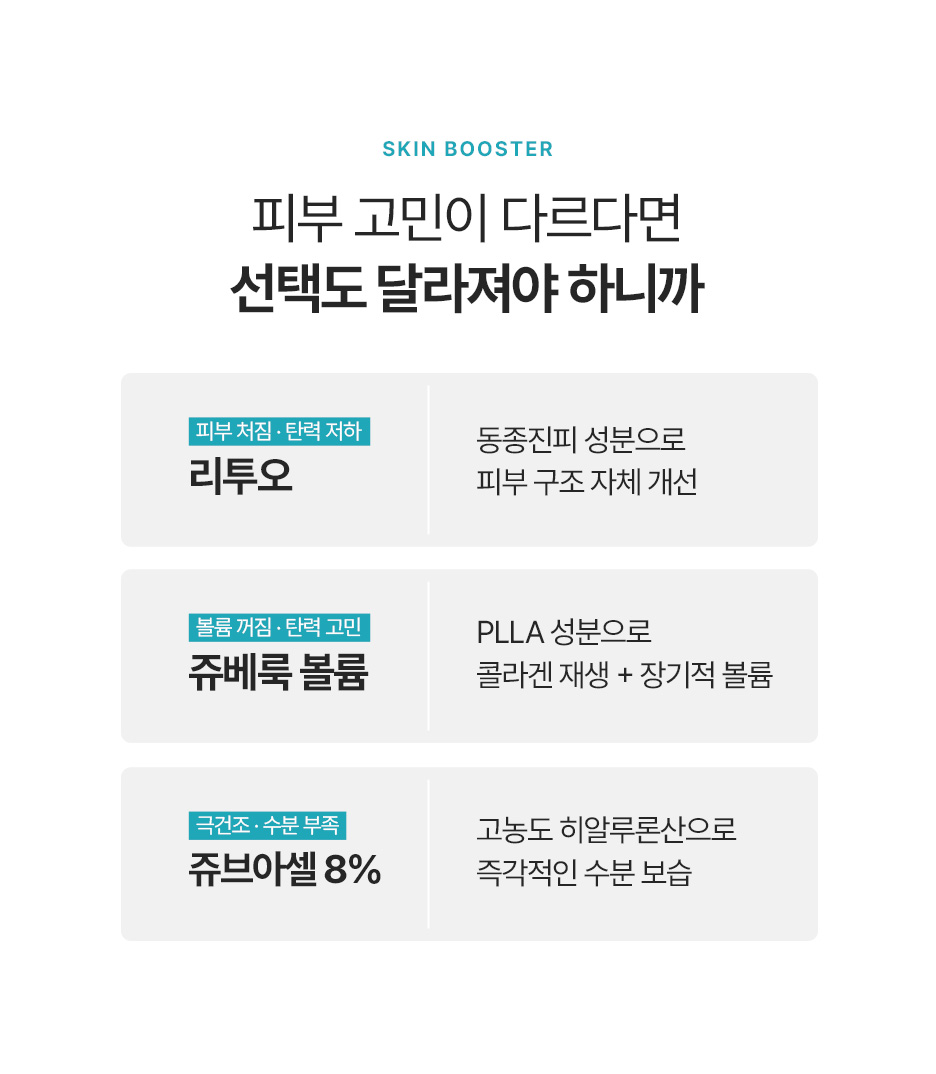
Rituo, Juvacel, Juvelook Volume, and more.
You hear people around you saying certain products worked well,
and online reviews are everywhere,
which somehow makes choosing even harder.
In that case, first think about one thing.
What bothers you most about your skin right now,
and what kind of change you're hoping for.
Looking into the types of skin boosters
is ultimately about finding the choice that fits your concerns.
A product everyone says is great. Will it work for me, too?
Rituo and Juvacel use human acellular dermal matrix (hADM),
while Juvelook Volume is primarily made of PDLLA and hyaluronic acid.
They are often researched together as collagen injections,
but their ingredients and characteristics are different.
Because each type of skin booster has its own characteristics, people tend to start by comparing products.
But what you should really consider first is what your biggest concern is with your skin.
Some people are bothered by dull skin texture,
others are concerned about firmness, and some feel they lack volume in a specific area.
So rather than simply taking someone else's review at face value,
it's better to sort out your own concerns first.
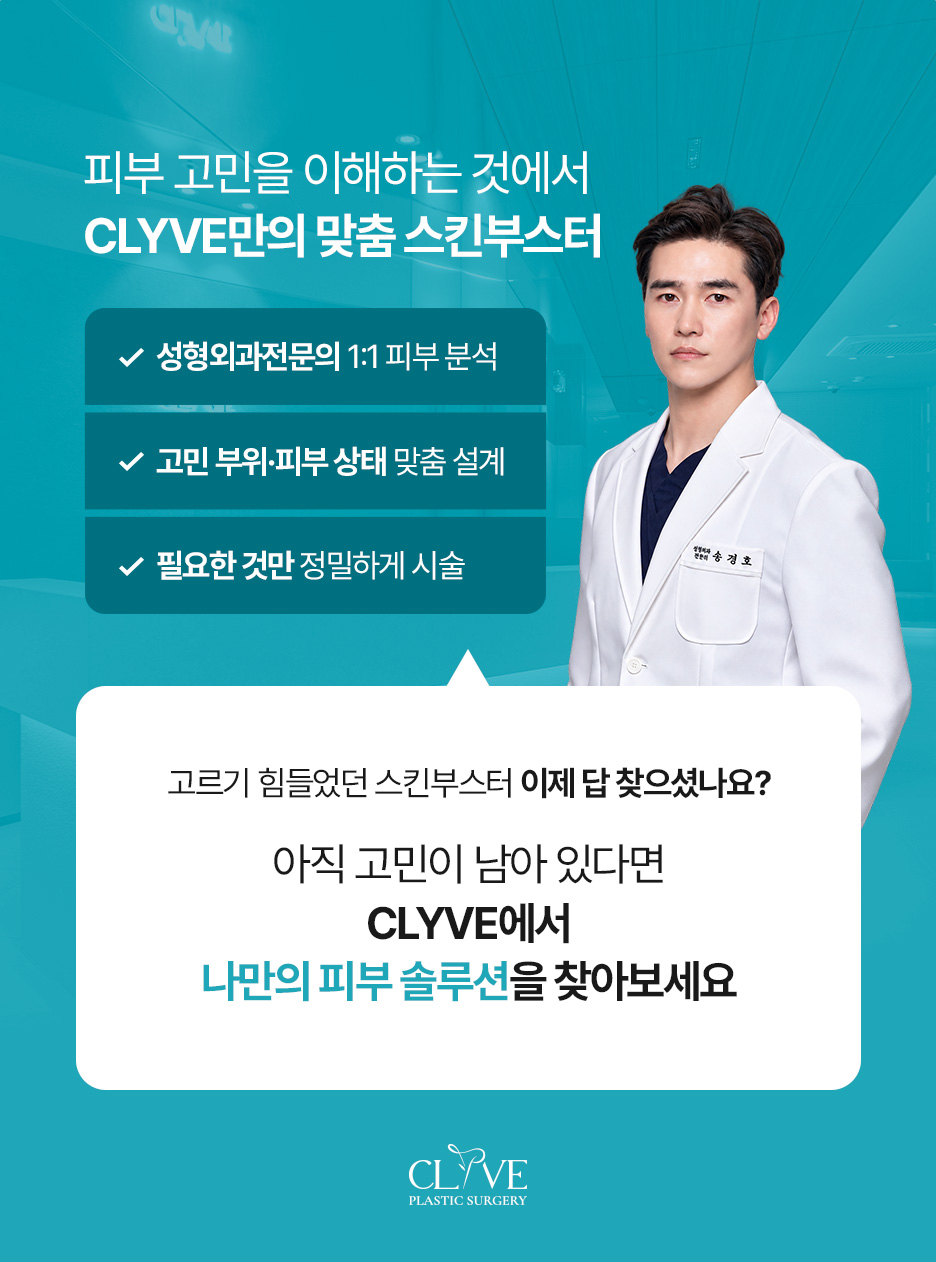
At Cleave, the clinic director personally listens to your concerns
and places importance on examining your current skin condition.
We talk through what has been bothering you day to day, when the concern first started,
and how much change you're hoping for, step by step.
During a consultation, you may find
that you start considering a different direction from the treatment you first had in mind.
Rather than choosing a product first and fitting your skin to it,
it's necessary to check your skin condition and concerns first, then look at your options.
Being able to ask your own questions and receive explanations is also something not to overlook in a consultation.
Will you look better if you just fill in the hollow areas?
When one area of your face bothers you, it's easy to want to improve only that spot.
But the parts of your face don't move independently of each other.
Skin thickness, tissue condition, fat distribution, and even bone structure
all work together to create your overall impression.
For example, even if the hollowness around your cheeks is your concern, that area is hard to look at on its own.
You need to consider the volume of the surrounding areas and how it connects to the balance of your entire face.
That is also why Cleave looks at the harmony of the entire face
together, rather than focusing on one area alone.
Rather than only solving the concern right in front of you, we consider your natural facial features
and the balance of the surrounding areas as well.
Rather than an overly dramatic change,
what kind of change would suit the impression you already have
is what matters most.
There is one more thing to consider.
Just because you have several skin concerns
doesn't mean you need to undergo several treatments.
During consultation, the treatment you first had in mind
may not actually be necessary for your current condition.
In that case, you should be able to hear not only why a treatment is recommended,
but also why it isn't necessary to proceed right now,
and get an explanation for both.
Cleave examines what is needed,
and values an approach that leaves out unnecessary treatments.
Just as important as adding something
is avoiding choices that don't suit your current condition.
When looking into collagen injections, too,
check whether they match your skin condition and the purpose of the treatment.
Understanding a product's characteristics
and making the choice you actually need are two somewhat different things.
What you miss when you only compare skin booster prices
It's only natural to compare prices while looking into treatments.
Skin booster prices can vary depending on the product type, the amount used,
the treatment area and extent, and the items included.
Even for the same product, the cost can change depending on the scope of application or the treatment plan,
so it's hard to judge based on price alone.
So when checking skin booster prices,
check which product is being used,
which areas will be treated and how much,
and what items are included in the quoted price.
It's a good idea to review all of these together.
If you have any questions,
ask and confirm them in advance during your consultation.
But what matters just as much as price is the content of the consultation.
Who listens to your concerns and explains them,
why a treatment is being suggested,
and whether there are parts that don't necessarily need to be done.
You should be able to ask about all of this freely.
At Cleave, the clinic director personally listens to your concerns
and aims for care that examines your current skin condition and reviews the need for treatment together with you.
Based on your current condition,
we explain which options you might consider,
so that you can fully check any questions you have.
We place meaning on the consultation process itself.
The more types of skin boosters there are, the harder the choice can become.
That's why it's worth checking whether they truly listen to your story,
whether they examine your facial features and skin condition together,
and whether they explain the reasons for a recommendation in a way that's easy to understand.
Skin treatments are not simply about choosing a famous product.
It starts with examining what concerns you have about your skin right now,
what changes you need,
and getting to know these step by step.
When choosing a skin booster type,
please keep this in mind.
Cleave begins with a consultation that listens to each person's story,
and aims to think through the choices each person actually needs together with them.
















Frequently Asked Questions
Are all skin booster types made of the same ingredients?
No, they are not. Rituo and Juvacel are primarily made of human acellular dermal matrix (hADM), while Juvelook Volume is primarily made of PDLLA and hyaluronic acid. The article explains that each type of skin booster uses different ingredients and has different characteristics.
Are there differences among collagen injections?
Yes, there are. Although they are often researched together under the label "collagen injections," the article explains that each product uses different ingredients and has different characteristics. For that reason, it recommends examining your own skin concerns before choosing a product.
What determines skin booster prices?
Prices can vary depending on the product type, the amount used, the treatment area and extent, and the items included. Even for the same product, the cost can change depending on the scope of application or the plan, so the article explains that it's difficult to judge based on price alone.
What should I look at when checking skin booster prices?
It's a good idea to review the product being used, which areas will be treated and how much, and what items are included in the price. Any questions are best asked and confirmed in advance during your consultation.
What should I check during a treatment consultation?
It's good to confirm the reason a treatment is being recommended and whether there are parts that don't need to be done right now. The article also suggests checking who listens to your concerns and explains them, and whether your facial features and skin condition are examined together.
If I have multiple skin concerns, do I need multiple treatments?
No. Having several concerns doesn't mean you need to undergo several treatments. The article explains that the treatment you initially had in mind may not be necessary for your current condition.
Clinic Info
Details
- 서울 강남구 도산대로 121 YK타워 5·6층
- 02-6212-8080
- Mon-Fri 10:00-19:00Sat 10:00-17:00 Closed days calendar ›
- Director 송경호
- clyveps.com