2026-09-20
Incisional vs. Non-Incisional Double Eyelid Revision: 3 Key Factors to Check When Choosing a Revision Clinic
Learn the 3 essential factors to evaluate before double eyelid revision surgery: identifying why the crease loosened, deciding between full or partial correction, and choosing the right clinic approach without unnecessary incisions.

Incisional vs. Non-Incisional Double Eyelid Revision: 3 Key Factors to Check When Choosing a Revision Clinic

After undergoing double eyelid surgery, a crease that initially looked well-defined may begin to fade or loosen on just one side over time.
Especially when the inner corner or the outer tail of the eye starts to look slightly hooded or droopy, you naturally begin to wonder if a revision surgery is needed.
At this moment, an incisional double eyelid revision is often the first option that comes to mind.
However, having had a non-incisional (buried suture) method previously does not mean only non-incisional revision is possible,
nor does having a loosening crease mean that an incision is always mandatory.
The first step is always analyzing where the crease loosened and why it lost its definition.
Therefore, when looking for an eyelid revision clinic, it is essential to evaluate how they examine your current eyelid condition rather than deciding on the surgical technique right away.

First, identify why the crease loosened in the first place
When a double eyelid loosens, many people simply assume that the suture has come undone.
However, several underlying causes can lead to a weakened crease.
The thickness of the eyelid skin, the amount of fat and soft tissue, and the degree of remaining adhesion from the previous surgery can all influence how the eyelid appears.
In some cases, only one side loosens noticeably, or just the inner corner or outer tail becomes lower.
Therefore, when considering double eyelid revision, it is necessary to determine whether the entire line is problematic or if only a specific segment has weakened.
Identifying the root cause allows for an accurate assessment of whether a non-incisional revision is feasible or if an incisional approach needs to be considered.

Second, determine whether the entire line needs to be redone
When people think of incisional revision surgery, many imagine completely recreating the crease from start to finish.
However, if the overall shape of the existing double eyelid remains sound and only a specific section has loosened, it may not be necessary to touch every single area.
For instance, if only the inner corner is hooded or the outer line appears shortened, corrective action can be centered specifically on that area.
In such situations, re-securing only the necessary points—similar to a non-incisional revision approach—can serve as a practical option.
What truly matters is not the name of the surgical technique, but whether the existing crease can be preserved and precisely how much correction is required.
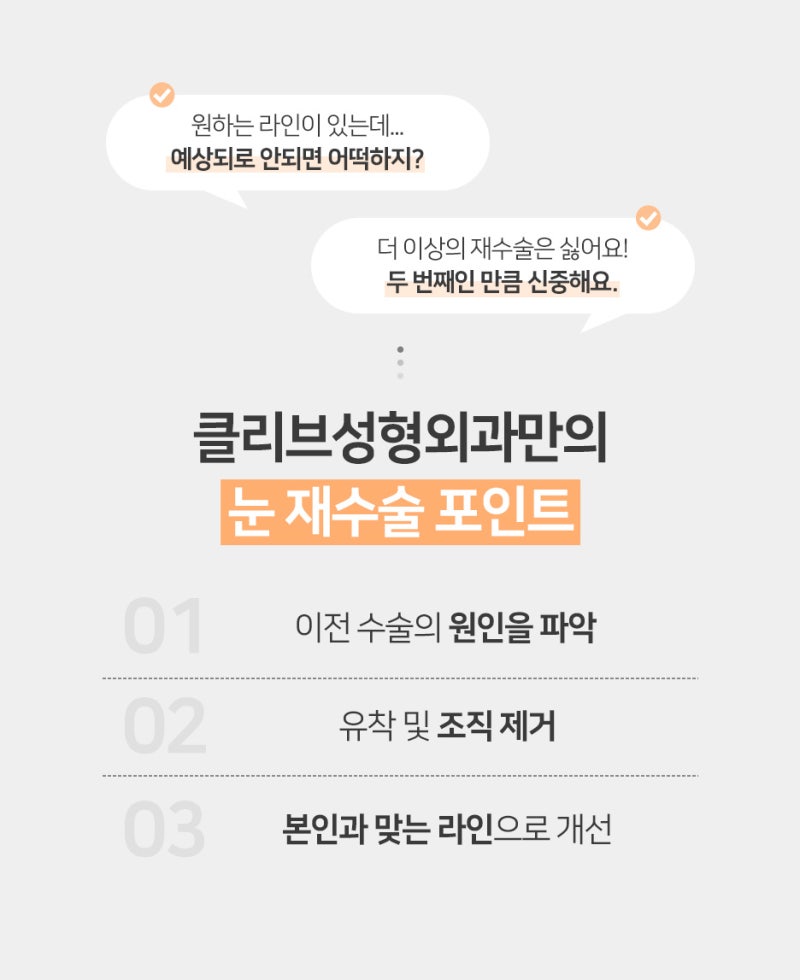
If you had an incisional surgery before, must you undergo an incisional revision?
Those who previously had double eyelid surgery via the incisional method often assume that any revision must also be done with an incision.
However, the previous surgical technique alone should not dictate the revision approach.
The condition of the existing incision line, the presence and degree of scar tissue, and the exact location of the loosening all influence how the surgeon should approach the revision.
In particular, if only a small segment has loosened, correction may be possible without creating an additional incision.
Conversely, depending on tissue adhesions or excess skin, an incisional method might indeed be necessary.
For this reason, double eyelid revision should start with an in-depth re-evaluation of your current eyelid anatomy, rather than simply repeating the previous method.

Third, assess how well the existing line can be utilized
When choosing a clinic for eyelid revision, you should not look only at how well they design a brand-new line.
Within an existing double eyelid, certain segments may remain completely natural, while only specific areas fall short of expectations.
If there is nothing fundamentally wrong with the existing line, redesigning the entire fold or manipulating unnecessary skin can potentially compromise its natural contour.
That is why in revision surgery, deciding what to preserve is just as crucial as deciding what to reshape.
Even when considering a non-incisional revision, it is vital to evaluate existing tissue adhesions, crease height, and left-right asymmetry together to determine the exact points needing correction.

When can a non-incisional revision be considered?
Non-incisional revision is not a method reserved exclusively for patients whose initial surgery was non-incisional.
It can be considered when most of the current line is well-preserved but a portion of the inner or outer corner has loosened, or when the line on one eye has dropped, causing noticeable asymmetry.
It is also applicable when specific adjustments are needed, such as when the middle of the line looks weighed down or the outer tail ends prematurely.
However, even if the appearance seems similar on the surface, underlying adhesions and skin elasticity differ from person to person, meaning the same solution cannot be applied across the board.
Consequently, rather than relying solely on photographs, a direct in-person evaluation of your eyelid condition is essential.
3 Key considerations when selecting an eyelid revision clinic
When researching incisional or non-incisional eyelid revision, many patients start by comparing procedure names.
However, what matters most in revision surgery is not the specific technique label, but how accurately the clinic evaluates your current eyelid anatomy.
Look closely at whether they evaluate these three factors: the cause of the loosening, whether full or partial correction is required, and how much of the existing line can be retained.
A trustworthy eyelid revision clinic should not simply default to choosing between incisional or non-incisional; it must inspect remaining adhesions, skin quality, left-right differences, and the overall shape before determining the scope of surgery.
Ultimately, a successful eyelid revision is not about remaking everything from scratch, but about accurately identifying what needs correction in your current eyes and approaching it with a tailored scope.





Frequently Asked Questions
If my double eyelid crease loosens, must I have an incisional revision?
No, an incisional method is not mandatory for revision surgery. Depending on the cause and location of the loosening, skin thickness, and existing tissue adhesion, it is often possible to correct only the necessary points using a non-incisional approach.
If my previous surgery was incisional, can revision only be done with an incision?
No, prior incisional surgery does not automatically restrict your revision options to an incisional method. After evaluating the existing scar line, tissue condition, and the area that loosened, partial corrections can sometimes be achieved without any additional incisions.
Under what eye conditions can non-incisional revision be considered?
It can be considered when most of the existing crease remains intact and only specific sections have loosened or become asymmetrical. It is often effective when correcting a shortened line at the inner/outer corners or addressing a lower crease on one side.
What is the most important factor when choosing an eyelid revision clinic?
Ensure that the clinic accurately diagnoses the exact cause of the loosening and defines an appropriate scope of correction. Rather than rushing into a specific surgical method, look for a clinic that thoroughly evaluates skin condition, internal adhesions, and symmetry to treat only what is necessary.
Clinic Info
Details
- 서울 강남구 도산대로 121 YK타워 5·6층
- 02-6212-8080
- Mon-Fri 10:00-19:00Sat 10:00-17:00 Closed days calendar ›
- Director 송경호
- clyveps.com