2026-09-18
Revision Double Eyelid Surgery Clinic: The Most Common Misconceptions About Eyelid Revision
Revision double eyelid surgery requires evaluating internal adhesions, scarring, and skin laxity before designing a new crease, ensuring safe and personalized results.

Revision Double Eyelid Surgery Clinic: The Most Common Misconceptions About Eyelid Revision

When talking to patients who are considering a revision double eyelid surgery clinic,
many of them initially assume the process is much simpler than it actually is.
“I don't like the crease, so we can just redraw it, right?”
“They look asymmetric; I just need them to match.”
However, when looking closely at the eyes in person, the problem is often not just about the line itself.
Eyes that have undergone surgery once
may have scarring or internal adhesions left behind,
and the remaining skin laxity and eyelid tissue condition are no longer the same as they were before.
Therefore, rather than simply creating a new crease,
revision surgery begins with thoroughly assessing the current state of your eyes.

Starting from the reason you decided on revision
The motivation for considering a revision varies from person to person.
The creases on both sides may appear asymmetrical,
or the fold may have turned out higher or lower than expected.
Some feel their eye shape has changed over time
as the eyelid skin begins to sag with age.
Even if the results seemed fine right after the initial procedure,
certain details might become increasingly bothersome as time passes.
During consultations, behind the simple statement “I want a revision,”
lies a unique set of concerns for every individual.
When searching for a revision double eyelid surgery clinic, rather than deciding on a surgical method first,
it is best to start by discussing why you began considering revision in the first place.
A second surgery has an entirely different starting point
At a revision double eyelid surgery clinic, discussing the primary surgery is unavoidable.
We must evaluate the initial surgical technique used, how much skin remains,
and the degree of internal scarring and adhesions.
Because the eyelids have already undergone surgical trauma,
the skin and surrounding tissues cannot be in their original state.
Particularly when dense adhesions are present,
the surgical approach must be completely different
from simply making a new fold on top.
Therefore, when researching a revision clinic, it is wise to see if the surgeon discusses your prior surgery in depth,
rather than focusing solely on the current visual appearance.

“I want this specific type of crease”
During consultations at a revision clinic,
many patients bring photos showing their desired fold shape.
“I want it slightly lower.”
“I prefer it not to look too deep this time.”
Of course, sharing your aesthetic preferences is always welcome.
However, just having a preferred crease in mind
does not mean the surgical plan can be based purely on that shape.
Depending on the adhesions and tissue conditions from the previous operation,
the feasible surgical techniques may vary considerably.
Ultimately, a proper revision double eyelid surgery clinic must weigh your desired outcome
alongside the anatomical reality of your current eyelids.

Revision surgery is not limited to a single approach
The technique used for revision varies depending on each individual case.
Some require epicanthoplasty reversal,
while others may need an incisional revision.
Ptosis correction or fat repositioning may also need to be addressed
together at a revision double eyelid surgery clinic.
Rather than deciding on the name of a procedure beforehand,
it is best to identify which aspect of your eyes bothers you the most right now.
Even under the broad category of revision surgery,
the recommended direction will change depending on your initial procedure and current anatomical tissue status.
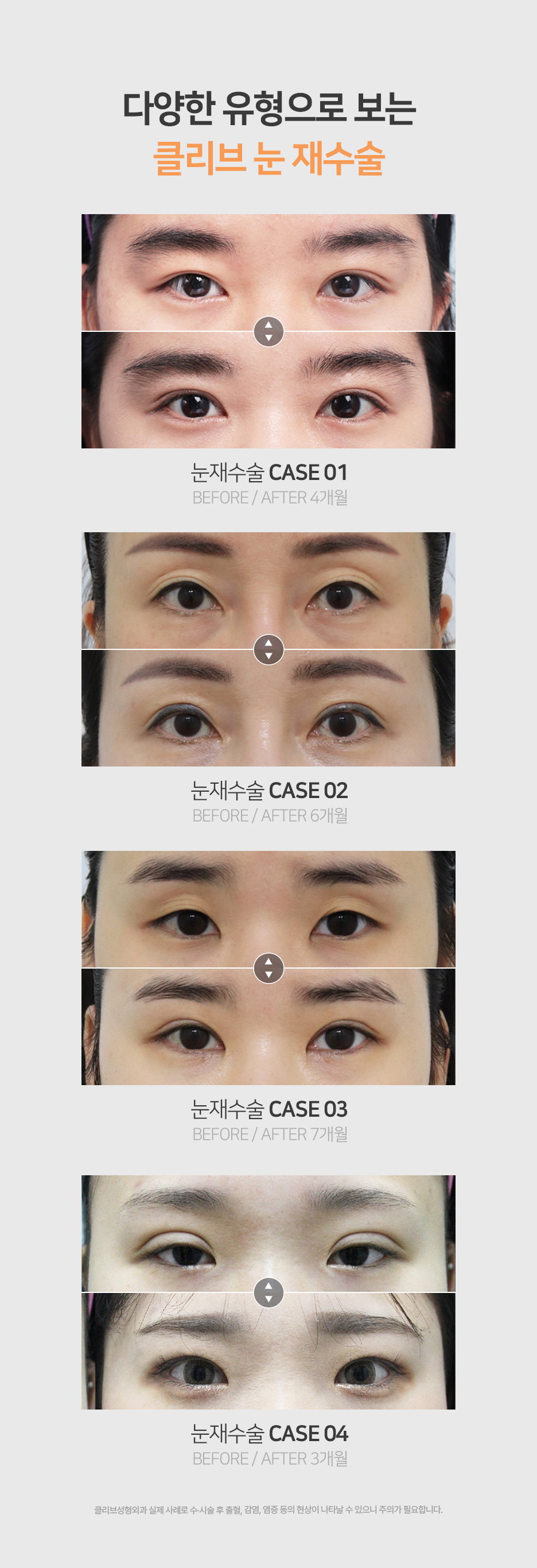
Similar appearances can be very different upon closer inspection
When browsing before-and-after cases of revision surgery,
you might come across eyes that look just like yours.
Yet upon closer examination, each patient's actual underlying issues differ.
For one person, the crease height is the main concern,
while for another, asymmetry between the two eyes is the primary issue.
The scope of prior surgeries may also differ,
such as whether they previously underwent epicanthoplasty or ptosis correction.
Therefore, when reviewing clinical cases, rather than only checking if the before-and-after looks similar to what you want,
it is helpful to understand why that revision was performed.
Even if two pairs of eyes appear similar on the outside, their internal tissue conditions are never identical.

Revision surgery begins with ‘now,’ not simply ‘again’
When thinking of revision,
people usually focus first on what crease they want to create anew.
However, an in-depth consultation at a revision double eyelid clinic starts by exploring how your first surgery went,
how your eyes have changed since then,
and what currently concerns you most.
Through detailed conversation and a thorough physical examination,
we often uncover underlying factors that differ from your initial assumptions.
If you are looking into revision double eyelid surgery,
rather than merely comparing similar case photos or technique names,
take the time to calmly discuss why you are considering revision in the first place.
Because your eyes have already undergone surgery once,
it is crucial that your second procedure starts from the current, real condition of your eyelids.















Frequently Asked Questions
Can I always achieve my desired crease immediately through revision surgery?
Not always. Depending on the condition of your eyelid tissues—such as adhesions, internal scarring from previous surgery, and remaining skin laxity—feasible surgical methods and achievable crease designs can vary. A detailed evaluation of your current eyelid state must come first.
What are the primary reasons people seek revision double eyelid surgery?
Common reasons include asymmetry between both eyes, dissatisfaction with crease height or depth, and eyelid sagging over time. Even if initial outcomes were satisfactory, aging skin laxity or unnatural lines can emerge later, prompting the need for revision.
What surgical techniques are used in double eyelid revision?
Procedures are tailored to individual needs and may include incisional revision, ptosis correction, epicanthoplasty reconstruction, and fat repositioning or removal. There is no single standardized method; the plan depends heavily on your prior surgery and current anatomical status.
Will my surgery be the same as someone else with similar-looking revision results?
No. Even if eye appearances seem alike, internal conditions differ. Previous surgical history (such as canthoplasty or ptosis correction), adhesion severity, and remaining tissue vary from person to person, requiring a customized surgical strategy tailored specifically to your eyes.
Clinic Info
Details
- 서울 강남구 도산대로 121 YK타워 5·6층
- 02-6212-8080
- Mon-Fri 10:00-19:00Sat 10:00-17:00 Closed days calendar ›
- Director 송경호
- clyveps.com